September 23, 2005
Cave Men And Crack Whores
OK, so Jonah Goldberg is kind of known for his colorful analogies, but I had to salute today when he pulled off these two in succession:
Sure: Bush’s response to Katrina wasn’t racist, and not nearly so incompetent as it seemed at first, but it was still far less than sufficiently competent — and it was indisputably politically disastrous. As we look to the future, what are we supposed to say? Hell no his overspending isn’t irresponsibly lavish! His overspending is simply responsibly lavish! The porkbusters fight is fun now, but not since early cave men tried to train grizzly bears to give them tongue-baths has a project seemed more obviously doomed to end in disappointment. Expecting Congress — of either party — to give back pork which has already been approved and passed into law is like expecting crack whores to give refunds days after services have been rendered.
Gelernter's Proposal
David Gelernter proposes taking the abortion issue away from the courts and putting it back where it belongs:
How can democracy reassert itself given American political reality? Congress could propose, and the nation could ratify, a two-part constitutional amendment.Part one would legalize abortion with suitable restrictions. Part two would nullify Roe and reaffirm that only Americans and their elected representatives have the power to make law in this nation. All courts would be implicitly instructed by this slap-in-the-face clause to butt out of law-making.
Obviously, pro-abortion liberals would gain if such an amendment were ratified. Anti-abortion conservatives would too — not in their fight against abortion, perhaps, but as Americans. They can live in a nation where abortion is legal and democracy is under a cloud, or a nation where abortion is legal and democracy has been resoundingly reaffirmed.
Abortion poses vitally important problems, but liberty and democracy are even more important. If we lose them, we lose everything — including all possibility of making things better in the future.
Overdue Attention
The national media are finally discovering the Cleveland Indians. SI's Albert Chen has a feature on them tonight along with their game story on the Tribe's 90th win.
And this CBS story on the White Sox' ongoing fade rightly credits the stellar play of the Tribe as the main reason Chicago appears to be choking.
September 22, 2005
Able Danger Hearings
Congressional hearings on the Able Danger disclosures began yesterday, and the Washington Times previewed the testimony. At The Corner, Andy McCarthy (here, here, and here) and John Podhoretz (here and here) have posted their various theories and observations.
The Pentagon has barred several witnesses from testifying before Sen. Specter's committee, and they are being criticized for doing so. Out front on this story as usual is Ed Morrissey, who scoffs at the notion that there are any national security issues or fears of the disclosure of intelligence gathering techniques at work here. It's old fashioned CYA...
After all, if the Senators want to discuss how the identifications worked, they would gladly go into closed session for that testimony. What the Committee and the rest of us want is open testimony about what they found in relation to 9/11 and the known hijackers, who they identified, what they did with that information -- and who insisted on covering it up, both at the Pentagon and on the 9/11 Commission.None of that comes under the heading of national security -- it falls into the category of covering some high-ranking ass...
...The American people suffered the worst attack on our soil four years ago. We deserve answers about how that attack could have been prevented. The Pentagon has five witnesses that speak directly to that issue who have been prevented from speaking to the representatives of the people. Arlen Specter needs to subpoena those five witnesses, all of the senior officers in the chain of command for Able Danger, and Donald Rumsfeld himself to answer for why the Pentagon will not cooperate. Four years of hiding Able Danger is long enough.
Check out Ed's previous Able Danger post as well.
September 21, 2005
Exclamation Point

It was a tight game tonight until John Garland tried to get a high 3-2 fastball past Travis Hafner in the 8th inning. Hafner muscled it out for a 3-run homer, and added another clout in the 9th for good measure. Hafner reached 30 home runs and 100 RBI tonight, stats that are more impressive when you realize he missed 10% of the season after getting hit in the face with a pitched ball. His 1.008 OPS (OBP + SLG) trails only Ortiz and A-Rod in the AL and is 5th in all of MLB.
This blog's preoccupation in recent days with sports, especially baseball, is an accurate reflection of how it consumes my consciousness when the Indians are in the pennant race this time of year. I had almost forgotten what it was like.
The Legend
The Bengals are 2-0, and that's not the only thing that looks upside down in the NFL after two weeks. David Fleming of Page 2 reflects on this state of affairs with a multiple choice quiz. Here's Question #1:
John Elway once said the worst thing about getting old as a quarterback is that just as the game begins to slow down for you mentally you begin to break down physically, a statement that now seems to apply to:
A. Brett Favre
B. The Packers' quarterback
C. Hall of Famer, Brett Favre
D. Favre, Brett
E. All of the above
It doesn't give the Browns any credit for beating Favre on Sunday, but it's funny anyway.
The U. N. - Unplugged
The power was out only for a short time, but Claudia Rosett reflects on what might have been.
September 20, 2005
They Just Play
Jayson Stark of ESPN.com:
This can't be happening. Can it?A 15-game lead, melting like the polar ice caps?
A magical season, turning messier than a mudslide?
This can't be happening. But it is. It's happening to those Chicago White Sox. Right before our eyes.
Seven weeks ago, the White Sox were 34 games over .500 -- and the Cleveland Indians were four over. Four.
So everybody who figured they'd be waking up on the morning of Sept. 20, finding those same two teams suddenly separated by 2½ games, raise your hands. We'd like to come hang out with you on your next trip to the Powerball machine...
...Whether the Indians want to know this or not, they are now within reach of doing something not just historic but borderline impossible. Wiping out a 15-game lead with two months to play? What are the odds of that?
Stark goes on to document the worst ever historical collapses by first place teams for perspective. I wasn't aware that the White Sox were so close to making baseball history. The whole Stark piece is must reading for Tribe fans.
Count me as still skeptical that we can overtake the White Sox. But I am amazed at what has happened to and for the Indians in the last 45 games or so. When they were 60-52 after winning six of seven, I figured that if they could go 15-5 against the Royals and the Devil Rays and play .500 ball (15-15) against everybody else, they could reach 90 wins, the upper end of anyone's April expectation of what this team could do.
Soon after that came the deflating sweep at home by the Devil Rays, but the Indians are 25-7 since that debacle, and have lost consecutive games only once during that stretch. That leaves them two short of 90 with 12 games to play, and now the only question is how many wins over 90 it will take to make the playoffs one way or another.
And to be fair, if I'm linking back to April's 90-win prognostication, I have to also recall my post-All Star Game blues when I said they didn't look like a playoff-caliber team. Never more glad to be wrong.
Roberts Endorsements
So far, the Washington Post, Boston Globe and now the reliably liberal L.A. Times have endorsed the confirmation of Judge Roberts as chief justice, all of which leaves the New York Times looking kind of silly. Here's how the L.A. Times editorial begins:
It will be a damning indictment of petty partisanship in Washington if an overwhelming majority of the Senate does not vote to confirm John G. Roberts Jr. to be the next chief justice of the United States. As last week's confirmation hearings made clear, Roberts is an exceptionally qualified nominee, well within the mainstream of American legal thought, who deserves broad bipartisan support. If a majority of Democrats in the Senate vote against Roberts, they will reveal themselves as nothing more than self-defeating obstructionists.
That sounds about right.
Eyeing The U.N.
Power Line points to a new site devoted to keeping tabs on the United Nations. It's called Eye on the U.N., and is run by Anne Bayefsky among others. I've browsed the site a bit, and the authors list is impressive. The Bayefsky archive alone is worth some of your time, even it doesn't contain this definitive treatment of the history of The U.N. and the Jews, (pdf document) from Commentary Magazine.
Related:
September 19, 2005
Dueling Sports Analogies
Mark Steyn is an entertaining read as usual, this time on the Roberts hearings.
Bush's Hand Up
President Bush's initiative to provide a "hand up" as opposed to a "handout" for victims of hurricane Katrina is praised by Michael Barone and David Brooks. Here's a sample from the Barone column:
...despite the Great Society tone of his speech, he did not promise another Great Society. He proposed instead a Gulf Opportunity Zone -- presumably, a tax-free status to encourage investment. He called for Worker Recovery Accounts of up to $5,000 for job training, education and childcare. He proposed an Urban Homesteading Act on federal lands.Bush's liberal critics have been hoping that the Katrina disaster would increase support for big government, and they have a point when they say that there are some things only government must do and that it -- or they: local, state, federal -- must do them well. Bush's proposals use government differently. Like the GI Bill of Rights and the no-down-payment VA home mortgages of Franklin Roosevelt, Bush's Worker Recovery Accounts and Urban Homesteading would help people out, but only those who in turn do something to lift themselves up. And his Opportunity Zone turns on its head the liberal notion that the most effective way to help the poor and helpless is to tax everyone else heavily and hand out money to those in need.
(Because the N.Y. Times has decided to begin charging for online readers to view their editorial content effective this week, I am pasting the full Brooks piece at the link below. Brooks is the only person I will miss reading at the Times site. Now I'll probably have to click all the way over to Free Republic.com to read him.)
The New York TimesSeptember 18, 2005
A Bushian Laboratory
By DAVID BROOKSOn Oct. 5, 1999, George Bush went to the Manhattan Institute and delivered the most important domestic policy speech of his life. In what was mostly a talk about education, he made it quite clear he was no liberal. But he also broke with mainstream conservatism as it then existed.
He distanced himself from the cultural pessimists, the dour conservatives who were arguing that America was sliding toward decadence. Then he bluntly repudiated the small government conservatism that marked the Gingrich/Armey era.
It's not enough to cut the size of government, Bush said, or simply get government out of the way. Instead, Republicans have to come up with a positive vision of "focused and effective and energetic government."
With that, Bush set off on a journey to define what he called "compassionate conservatism" and what others call big government conservatism.
It's been a bumpy ride. Over the past five years, Bush has overseen the fastest increase in domestic spending of any president in recent history. Moreover, he's never resolved the contradiction between his compassionate spending policy and his small-government tax policy.
But gradually and fitfully, Bush has muddled his way toward something important, a positive use of government that is neither big government liberalism nor antigovernment libertarianism. He's been willing to spend heaps of federal dollars, but he wants that spending to go to programs that enhance individual initiative and personal responsibility.
On Thursday, President Bush went to New Orleans and gave the second most important domestic policy speech of his life. Politically it was a masterpiece, proof that if the president levels with the American people and admits mistakes, it pays off.
But in policy terms, the speech pushed the journey toward Bushian conservatism into high gear. The Gulf Coast will be a laboratory for the Bushian vision of energetic but not domineering government.
Bush proposed an Urban Homestead Act, which will draw enterprising people to the area, giving them an opportunity to own property so long as they're willing to work with private agencies to put up their own homes. He proposed individual job training accounts, so much of the rebuilding work can be done by former residents. Children who have left flooded areas will find themselves in a proto-school-choice program, with education dollars strapped to each individual child.
This is an effort to transform the gulf region, which had become a disaster zone of urban liberalism. All around the South, cities are booming, but New Orleans never did. All around the country, crime was dropping, but in New Orleans it was rising. Immigrants were flowing across the land in search of opportunity, but as Joel Kotkin has observed, few were interested in New Orleans.
Now the Bush administration is trying to change all that. That means trying to get around the corruption that made the city such a rotten place to do business. The White House is trying to do this by devising programs in which checks and benefits flow directly to recipients, not through local agencies.
That means challenging the reigning assumptions. Right now the White House is fighting with Louisiana over where to house evacuees. The state wants to put temporary trailer parks on faraway military bases, where there are no jobs and where they will live in "abject dependency," as one senior White House official puts it. The Bush folks want to put temporary housing within a mile of the original neighborhoods so people can become self-sufficient as quickly as possible.
On Thursday, the president was honest about the cost of all this, but he only began to lay out a plan. The Bushies are still trying to figure out how to help people from broken families and those with mental disabilities. They're trying to figure out where to cut government to offset the costs. There are arguments about what New Orleans should try to be, a smaller controlled-growth Portland or a booming and spreading Houston.
Like Franklin Roosevelt in the New Deal era, Bush doesn't have a complete vision of what he wants to achieve. But he does have an instinctive framework.
His administration is going to fight a two-front war, against big government liberals and small government conservatives, but if he can devote himself to executing his policies, the Gulf Coast will be his T.V.A., the program that serves as a model for what can be done nationwide.
E-mail: dabrooks@nytimes.com
German Vote
I thought John Fund of OpinionJournal.com had some of the clearest analysis of the election in Germany. You'll also want to read Victorino Matus at TWS and Jim Geraghty at NRO. It was Geraghty who came up with what I thought was the "keeper" line of the day:
Eventually someone will form a government, but the negotiations could take weeks. The only time we get these kinds of messes in the American system is when a presidential candidate withdraws his concession, turns around the motorcade, and sends out his spokesman to declare, "our campaign continues." And thankfully, that's rare.
Insights On Iraq
Read Wretchard's post at Belmont Club on the operation in Tal-Afar by coalition forces earlier this month. The insurgents placed great importance on defending this stronghold and yet they were defeated decisively. Still, the prospects of avoiding Iraqi civil war are not terribly good.
And Greg Djerejian makes the case against a policy of announcing a phased, timed withdrawal, as advocated by Kevin Drum among others.
'Tis A Puzzlement
The hottest team in Major League Baseball drew an embarrassingly small crowd of 22,654 Sunday, as they cruised to an 11-0 win over the Royals. I heard a late night SportsCenter anchor the other night say "C'mon, Cleveland, you can do better than that!"
The Indians have won 12 of their last 13. It was a Sunday afternoon game. The weather was fine. This is the same town that sold out every game for over four complete seasons. I don't get it.
September 18, 2005
No. 1 For Romeo
Just wanted to congratulate Romeo Crennel for his first win as an NFL head coach. The Browns won a game that nobody in their right mind thought they would win, going up to the legendary Lambeau Field and knocking off the legendary Packers, led by the legendary Brett Favre, on the day the legendary Reggie White's number was retired.
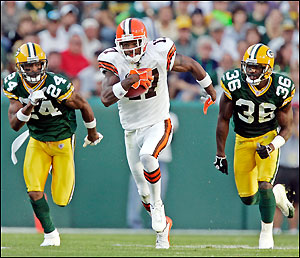
OK, the Packers aren't the team they have been in recent years, but that hardly makes this victory any less huge for the guys in the orange hats. It was most encouraging to see the Browns refuse to get conservative with a two point lead and a first down with under four minutes to go in the game. They caught the Packers thinking run with under two minutes to go and stunned them with a 62 yard TD to the tight end. By the time Brett the Legend scored again, there were only four seconds left on the clock.
Kudos to Trent Dilfer who had a terrific game, matching all of Favre's numbers except for the Legend's two interceptions. Heh.
Here's Braylon Edwards pulling away from two Packer defenders on his 80-yard TD reception.
September 16, 2005
On Top Of That, He's A Jerk
Bill Simmons has won me over with this bit of analysis from NFL Week One:
...Indy's near shutout of the Baltimore Ravens has more to do with Brian Billick's continued offensive ineptness than the Colts' unveiling a defense capable of winning in January. Billick might be the worst offensive coach in the history of the NFL. Billick is the man who decided Kyle Boller was a franchise quarterback. If not for Marvin Lewis and Ray Lewis' carrying the Ravens to a Super Bowl title, Billick would be in the unemployment line.
September 15, 2005
Bush's Two Mistakes
Peggy Noonan is on top of her game today as she critiques the Bush White House handling of Katrina and looks toward the rest of the second term:
...the White House made two big mistakes. The first was not to see that New Orleans early on was becoming a locus of civil unrest. When an American city descends into lawlessness, and as in this case that lawlessness hampers or prevents the rescue of innocents, you send in the 82nd Airborne. You move your troops. You impose and sustain order. You protect life and property. Then you leave. That's what government is for. It's what Republicans are for. The White House didn't move quickly, and that was the failure from which all failure flowed. The administration was slow to see the size, scope, variations and implications of the disaster because it was not receiving and responding to reliable reports from military staff on the ground. Because they weren't there. When the administration moved, it moved, and well. But it took too long.Second, lame gazing out the window is mere spin, not action. Soulful looks from the plane are spin. The White House was spinning when it should have been acting. I do not agree with the critique that Mr. Bush should have done a speech with a lot of "emoting." This is the kind of thing said by clever people who think everyone else is dumb. Bill Clinton felt everyone's pain, and that is remembered as a joke. What was Mr. Bush supposed to do, criticize the hurricane and make it feel bad? Say that the existence of bad weather is at odds with the American dream? Hurricanes come, disasters occur; don't talk, move. In this area the administration has gotten way too clever while at the same time becoming stupider...
...Mr. Bush is famously flinty. I sometimes think of what a friend said of him years ago: There are two misconceptions about Mr. Bush; one is that he's dumb, and the other is that he's sweet. He puts great emphasis on personal loyalty, and personal loyalty is important. But when that preference becomes a governing ethos, you wind up surrounded only by loyalists. His father wound up surrounded by tennis players. This doesn't help you govern...
...Mr. Bush probably needed a humbling experience. He just got one. May he absorb, understand, keep the helpful lessons, ignore the unhelpful ones, and waste no time being mad. And may he reach out to some old wise heads on the Democratic side who can give him a read on how his honest critics view him.
Enviros Stop Levee Work
The problems getting Louisiana levee reconstruction projects done aren't all about federal funding. Two recent articles are focusing on the substantial role of the environmentalists in delaying or stopping altogether federal government plans to complete levee projects in Louisiana, among other places. John Berlau explains that "levee" is a dirty word to these folks:
The Army Corps was planning to upgrade 303 miles of levees along the river in Louisiana, Mississippi, and Arkansas. This was needed, a Corps spokesman told the Baton Rouge, La., newspaper The Advocate, because “a failure could wreak catastrophic consequences on Louisiana and Mississippi which the states would be decades in overcoming, if they overcame them at all.”But a suit filed by environmental groups at the U.S. District Court in New Orleans claimed the Corps had not looked at “the impact on bottomland hardwood wetlands.” The lawsuit stated, “Bottomland hardwood forests must be protected and restored if the Louisiana black bear is to survive as a species, and if we are to ensure continued support for source population of all birds breeding in the lower Mississippi River valley.” In addition to the Sierra Club, other parties to the suit were the group American Rivers, the Mississippi River Basin Alliance, and the Louisiana, Arkansas and Mississippi Wildlife Federations.
The lawsuit was settled in 1997 with the Corps agreeing to hold off on some work while doing an additional two-year environmental impact study. Whether this delay directly affected the levees that broke in New Orleans is difficult to ascertain.
But it is just one illustration of a destructive river-management philosophy that took hold in the ‘90s, influenced the Clinton administration, and had serious policy consequences. Put simply, it’s impossible to understand the delays in building levees without being aware of the opposition of the environmental groups to dams, levees, and anything that interfered with the “natural” river flow. The group American Rivers, which leads coalitions of eco-groups on river policy, has for years actually called its campaign, “Rivers Unplugged.”
Over the past few years, levees came to occupy the same status for environmental groups as roads in forests — an artificial barrier to nature. They frequently campaigned against levees being built and shored up on the nation’s rivers, including on the Mississippi.
And Bob Tyrell recounts how Al Gore had a speech in New Orleans cancelled by Katrina in which he was to have blamed global warming for the hurricane season. Instead...
On Sept. 9 he spoke in San Francisco, where he said "The warnings about global warming have been extremely clear for a long time. We are facing a global climate crisis. It is deepening. We are entering a period of consequences." And he urged that "the leaders of our country be held accountable" for the flooding of New Orleans. Unfortunately he was addressing the Sierra Club, which was not the best place to bring up the flooding of New Orleans.The very day he spoke a congressional task force reported that the levees that failed in New Orleans would have been raised higher and strengthened in 1996 by the Army Corps of Engineers were it not for a lawsuit filed by environmentalists led by who else but the Sierra Club. Among those "leaders of our country" to "be held accountable" for the flooding of New Orleans, would Al include the Sierra Club? How about the Save the Wetlands stalwarts? According to a recent report in the Los Angeles Times, a 1977 lawsuit filed by Save the Wetlands stopped a congressionally-funded plan to protect New Orleans with a "massive hurricane barrier." A judge found that New Orleans' hurricane barrier would have to wait until the Army Corps of Engineers filed a better environmental-impact statement.
Now, because those who would have improved hurricane protection in New Orleans were prevented by the environmentalist rigorists, the wetlands are polluted and imperiled and New Orleans has suffered the damage that practical minds have been trying to prevent for three decades...
In addition to the Al Gores of the world, Tyrell cites also...
...a well-intentioned piece of legislation that has become a major stumbling block to improving the nation's infrastructure and energy production, the National Environmental Policy Act of 1970 (NEPA). The legislation might have been sensible at the time but it has grown like a bureaucratic cancer. Environmentalist lawyers have expanded its reach until it now entoils practically any construction done by the federal government in red tape that stops projects large and small, some mere pork barrel expense, some critical to the safety of the citizenry.
September 14, 2005
Bunts, Brownouts, And Broussard
What a bizarre game we saw at Jacobs Field Tuesday night. I've never seen a game like this one, but then I've only been watching baseball for about 45 years. Some of the weird plays and events that reminded me why baseball rules:
- A guy who was in a 1 for 23 slump coming into the game hit two home runs in his last two at-bats accounting for all five Indians runs.
- An Oakland batter was called out for interference with the catcher on a bunted ball in front of the plate. (The catcher interfering with the batter is a rare call, but much more common than this)
- About one third of the stadium lights went out in the sixth inning, causing a 21 minute delay.
- Indians manager Eric Wedge had a disagreement with the umpire's version of the strike zone, and got thrown out of the game without coming out of the dugout. He then proceeded to get his money's worth on the field and in the ump's face, demonstrating his flair for theatrics, and managing to get the crowd into the game for the first time. The embarrassing gathering of 21,000 had been comatose through the first six innings, doing a remarkable imitation of Indians batters to that point.
- The Indians made three errors, all in the early innings, none of which figured in the scoring for Oakland. This was mostly because the Indians defense also turned five double plays to minimize the damage.
- The last of the double plays came in the ninth, and saw closer Bob Wickman stumble over toward first base trying to cover the bag, throw himself into the path of the relay throw, smothering the ball while colliding with the batter, who failed to touch first base as a result of the collision. As the injured batter lay on the ground, Wickman calmly picked up the ball, and stepped on first to complete the double play.
- Pitcher Kevin Millwood, who leads the AL in ERA and in lowest run support, looked like he was in for another tough loss. He got through the top of the 7th, and saw the Indians tie the game to get him off the hook for the loss, but it seemed unlikely that he would come back out for the 8th with a pitch count already in the 90's. But he gutted it out, and Broussard gave him a win with his second homer with two outs in the 8th.
- Meanwhile, the Yankees scored 17 runs, and didn't gain any ground on the Indians. Heh.
Media Watch
The guys at Power Line do an exceptionally good job of identifying liberal bias in mainstream media and presenting it with cogent commentary. Two recent examples, here and here, are particularly well done, and worth the clicks.
September 13, 2005
NYT and Gaza
As AIM has noted, a respected liberal ripping the New York Times editorial page is a "man bites dog" story, and it gets people's attention. So I'm not sure how I missed the recent column by New Republic editor Martin Peretz on the treatment of the Gaza evacuation by The New York Times, until it was brought to my attention by an Accuracy in Media piece by Roger Aronoff. Both articles are worth reading in full, but here's a sample of Peretz railing at the Times, a paper he admits he can't do without, for focusing on the one violent exception to what was on the whole a very peaceful evacuation, given the emotional circumstances:
There was far more hysteria and hatred vented at the police in Chicago in 1968 (I was there) and at the marches on the Pentagon or the bust at Columbia University than there was in Gaza, and there were many more injured. No question about it. But it did not fit the Times' editorial line to admit the fact that almost no one was really hurt, and no one was killed, in Gaza. (I was not at Kfar Darom, the most extreme settlement, where paint, eggs, oil, and some apparently not-very-dangerous chemical agent were thrown at police and army by demonstrators. A few were injured, apparently none seriously. In any event, this distress occurred long after the Times editorial appeared.) For killings, the Times had to focus on the West Bank, where a "settler grabbed a security guard's gun and opened fire, killing several [there were actually four] Palestinians." The Times went on to say that this was "an act that Prime Minister Sharon rightly denounced as 'Jewish terror.'" (What he, in fact, said was that "it was an exceptionally grave Jewish act of terror.") It is indeed Jewish terror, as the atrocity in Shfaram was "Jewish terror," and the Jews of Israel have notably identified the crime with the extremism in their own political culture.
Once again, the renunciation and the denunciation cut through the entire society. But do the Times editorialists have no shame? Finally, they have shed their reluctance to call an act of terror "terror," but only when they can put the adjective "Jewish" before it. Was the Dolphinarium bombing in Tel Aviv, which merited no Times editorial, not Palestinian terror? And to how many of the dozens and dozens of other helter-skelter murders of Israelis has the Times affixed the term? The Jewish killer, standing in the Petakh Tikvah courtroom, asserted that "I hope someone also kills Sharon." When has a Palestinian terrorist been arrested and brought to a Palestinian court as an accused? Does the Times editorial page ever call the murder of 30, 40 innocent Iraqis a day — looking for work or at the market — terrorism? Hardly. It is insurgency.
Lots more where that came from.
The Media and Islam
Check out a terrific TCS piece by Stephen Schwartz on how media organizations, four years after 9/11, still don't understand Islam. That explains why they misreport and distort key features and concepts of Islam, and perpetuate myths about the faith, all of which leads to a false perception among the Western public. I learned a few things.
Spoiling The U.N. Party
Claudia's back, at NRO, explaining how the timing of the 60th birthday party for the U.N. could have been better:
There are by now too many signs that under Annan's stewardship the U.N. has already partied quite enough. President Bush owes it to his own constituents — who are not foreign heads of state, but American voters and taxpayers — to pull the punchbowl. Scandals at the U.N. have proliferated to where they need cross-indexing simply to keep track of, from incompetence to theft to bribery to money-laundering to rape — in (mix and match) New York, Geneva, Lebanon, Gaza, Iraq, and West Africa, to name just the short list of recent examples. In an 847-page report last week, Paul Volcker's U.N.-authorized probe into Oil-for-Food disclosed findings of corruption, waste, and top-level incompetence, all bathed in a "pervasive culture of responsibility avoidance and resistance to accountability." Annan, as he has done with U.N.-observed genocide in Rwanda and Srebenica, promptly took "responsibility" — though what that means in practice, as he parties right on, is anyone's guess.Nor is Volcker's investigation over. Next month he is expected to report on the widespread corruption among the thousands of companies that did business with Saddam Hussein's regime, via the U.N., under the 1996-2003 Oil-for-Food program. There could be more than a little embarrassment there for some of the heads of state now gathered for the festivities in New York. Saddam threw well-padded business to his pals, in places such as Syria, Lebanon, and Saudi Arabia, and especially among veto-wielding Security Council members France, Russia, and China — all of whom in 2002 and early 2003 opposed the U.S. and U.K. arguments for enforcing the U.N.'s own resolutions against Saddam. Annan had access at the time to the U.N.'s trove of confidential information confirming many specifics of this targeted and tainted trade carried out under the U.N.'s corrupted program. Had he spoken up then, to protect the integrity of the U.N.'s own operations and debates, he might enjoy some credibility today. He said nothing.
September 12, 2005
Tribe Sizzles
Late Sunday the Indians salvaged an otherwise disheartening weekend, definitively bouncing the Twins from the Wild Card race, 12-4. We took in both ends of the downtown doubleheader, roasting in the sun at Browns Stadium watching the Bengals' offense take apart the Browns, and then enjoyed a beautiful night at Jacobs Field as Grady Sizemore and Coco Crisp did the roasting. Here's hoping they can do for the Athletics what they did for the Twins, starting tonight.
September 09, 2005
How Soon They Forget
Browns (+3.5) over BengalsWhen in doubt, take the points. By the way, do you think Trent Dilfer ever brings his Super Bowl ring into work to show his teammates, leading to the following exchange:
Rookie on the team: "That thing is awesome! What team did you win it on?"
Trent (proudly): "The 2000 Ravens."
Rookie: "Cool. Who were you backing up that year?"
Trent (proudly): "Actually, I started every game."
Rookie (breaking up laughing): "C'mon, man -- I know you start for us, but we suck! You didn't start for no Super Bowl champs!"
Trent (grimacing): "No, seriously, I did -- I started that year."
(Awkward silence. Finally...)
Rookie (breaking up again): "Get the hell out of here!"
September 08, 2005
They Knew Better
The 9/11 Commission no longer exists, so they're not apt to answer Stephen Hayes' questions about why they chose to ignore virtually all Iraqi links to the 9/11 attacks. But the commission's credibility problems are getting worse, and those questions are going to be aired in new congressional hearings that are likely to deal with the Able Danger disclosures as well as the glaring omissions from the commission report of evidence showing Iraqi involvement, like the story of Ahmed Hikmat Shakir for starters.
It's tough to get a credible result from an investigation when your mind is made up before it begins. Hayes is again asking the questions, and the reporting he has done on Iraqi links to 9/11 is so impressive. And I mean two and a half years worth. From his latest...
Why would the 9/11 Commission fail to mention Abdul Rahman Yasin, who admitted his role in the first World Trade Center attack, which killed 6 people, injured more than 1,000, and blew a hole seven stories deep in the North Tower? It's an odd omission, especially since the commission named no fewer than five of his accomplices.Why would the 9/11 Commission neglect Ahmed Hikmat Shakir, a man who was photographed assisting a 9/11 hijacker and attended perhaps the most important 9/11 planning meeting?
And why would the 9/11 Commission fail to mention the overlap between the two successful plots to attack the World Trade Center?
The answer is simple: The Iraqi link didn't fit the commission's narrative.
As the two sides in the current flap over Able Danger, a Pentagon intelligence unit tracking al Qaeda before 9/11, exchange claims and counterclaims in the news media, the work of the 9/11 Commission is receiving long overdue scrutiny. It may be the case, as three individuals associated with the Pentagon unit claim, that Able Danger had identified Mohammed Atta in January or February 2000 and that the 9/11 Commission simply ignored this information because it clashed with the commission's predetermined storyline. We should soon know more. Whatever the outcome of that debate, the 9/11 Commission's deliberate exclusion of the Iraqis from its analysis is indefensible.
The investigation into the 9/11 attacks began with an article of faith among those who had conducted U.S. counterterrorism efforts throughout the 1990s: Saddam Hussein's Iraq was not--could not have been--involved in any way. On September 12, 2001, the day after the attacks, George W. Bush asked Richard Clarke to investigate the attacks and possible Iraqi involvement in them. Clarke, as he relates in his bestselling book, was offended even to be asked. He knew better.
Philip Zelikow, executive director of the 9/11 Commission, started from the same assumption. So did Douglas MacEachin, a former deputy director of the CIA for intelligence who led the commission's study of al Qaeda and was responsible for the commission's conclusion that there was "no collaborative operational relationship" between Iraq and al Qaeda. (Over the course of the commission's life, MacEachin refused several interviews with The Weekly Standard because, we were told, he disagreed with our understanding of the relationship between Iraq and al Qaeda.)
More On U.N. Corruption
It seems as though the release of the Volcker (IIC) report yesterday marks the beginning not the end of the fact-finding on the Oil-For-Food scandal. Several congressional probes are underway, and so far Annan/Volcker have controlled the lion's share of the documentation. That should be about to change.
And U.S. federal prosecutions of Alexander Yakovlev, and now Vladimir Kuznetsov are no doubt just the beginning. Here's the amazing Claudia Rosett, this time at Fox (stay tuned) on the widening of the criminal investigation into procurement practices under the Russian Yakovlev, which coincided with Russia being the No. 1 contractor to Oil-For-Food, as well as the nation most showered with Saddam's bribery cash. (Fox link via Roger Simon)
And over at NRO (she's everywhere) Ms. Rosett makes a much-needed point about the so-called "exoneration" of Annan on the Kojo Annan/Cotecna contract issue, which is a serious matter, but almost a trivial detail in the context of Annan's overall responsibility:
The problem here is that whatever the truth about the secretary-general’s family ties to U.N. business, he was responsible for a great deal more than simply that particular U.N. contract. Even after the many scandals broken so far, a full account of the U.N.’s management of Oil-for-Food — starting with Annan’s starring role as head of the organization — would be an eye-popping thriller, and probably the healthiest thing to hit the U.N. since its founding. Oil-for-Food was not a bookkeeping exercise. It involved oversight of Saddam Hussein, an oil-rich war-mongering tyrant who gamed every angle of one of the most corruption-prone relief programs ever devised. Out of more than $110 billion in oil sales and relief purchases supervised by the U.N., Saddam by some estimates grafted out anywhere from $10 to $17 billion. While the U.N. praised the program, Saddam used his ill-gotten money not only for palaces, but to rebuild despite U.N. sanctions his networks of secret bank accounts, illicit political payoffs and arms traffic — and squirreled away billions that congressional investigators say may be funding terrorism today.But if the preface to Volcker’s report is any guide, readers will find themselves slogging through such stuff as: “The Secretary-General — any Secretary-General — has not been chosen for his managerial or his administrative skills, nor has he been provided with a structure conducive to strong executive control and oversight.” In other words, as the preface also states, although the U.N. charter “designates the Secretary-General as Chief Administrative Officer,” the Volcker committee believes his real role has become that of “chief diplomatic and political agent of the United Nations.”
That leaves us with a secretary-general who is apparently excused from competent management, but also failed to alert the world to such vital political matters as Saddam’s attempts to corrupt the U.N.’s own Security Council via Oil-for-Food deals — information obvious from records the U.N. kept secret from the public, but not from Annan.
Related:
September 07, 2005
Volcker Report
The complete report of the IIC is now available (in pdf format) here.
September 06, 2005
No One In Charge?
The UN is guilty of "corrosive corruption", according to a long-awaited investigation published today into the handling of the multimillion-pound Iraq oil-for-food programme.The 1,000-page report by Paul Volcker, former head of the US Federal Reserve, found "serious instances of illicit, unethical and corrupt behaviour within the United Nations"..."The inescapable conclusion from the committee's work is that the UN organisation needs thoroughgoing reform - and needs it urgently."
The Volcker commission (IIC) web site is here, although as of this writing I am unable to access the five-page "Preface" released Tuesday.
A Reuters article on the upcoming report says it calls for sweeping new financial controls:
"An adequate framework of controls and auditing was absent," said the report's preface, released on its Web site. "There were, in fact, instances of corruption among senior staff as well as in the field."...
Indeed there were, but then the Volcker commission looks to the top of the U.N. organizational chart...and finds no one there...
...But the report said a major problem was that no one was in charge -- neither the Security Council, meant to supervise the program, nor the U.N. secretariat, the semi-independent U.N. aid agencies and the General Assembly. Therefore when problems arose decisions "were delayed, bungled or simply shunned."
I'm sure Kofi Annan appreciates this charitable reading of the situation, finding him guilty only of "mismanagement", and the kid glove treatment is to be expected, since Annan appointed Volcker and oversaw the investigation (while funding it with $30 million of Iraqi oil revenues.)
But the "no-one-in-charge" finding doesn't comport with what we know about how the Oil-For-Food program was actually run. From Claudia Rosett's definitive Oil-For-Food primer, here is part of her description of Annan's oversight of the program. It should be noted that references to the "U.N. Secretariat", or simply "The Secretariat" refer essentially to the staff and operations of the Secretary General's office (as opposed to the Security Council or the General Assembly) which was of course supervised by Kofi Annan personally. (emphasis mine - DW)
Introduced as an ad-hoc deal, Oil-for-Food soon took on the marks of a more permanent arrangement. It was a project in which Annan had a direct hand from the beginning. As Under-Secretary General, he had led the first UN team to negotiate with Saddam over the terms of the sales under Oil-for-Food. The first shipment went out in December 1996; the following month, Annan succeeded Boutros-Ghali as Secretary-General.Nine months later, in October 1997, Annan tapped Benon Sevan, an Armenian Cypriot and longtime UN official, to consolidate and run the various aspects of the Iraq relief operation under a newly established agency called the Office of the Iraq Program (but usually referred to simply as Oil-for-Food). Sevan served as executive director for the duration, reporting directly to Annan. The program was divided into roughly six-month phases; at the start of each phase, Sevan would report and Annan would recommend the program’s continuation to the Security Council, signing off directly on Saddam’s "distribution plans." ...
...If final responsibility lay anywhere at all, it lay with the Secretariat. It was this body that fielded a substantial presence in Iraq (the U.S., apart from weapons inspectors ejected early on, had none), employing at the height of the program some 3,600 Iraqis plus 893 international staff working in Iraq for the nine UN agencies coordinated by the Oil-for-Food office; another 100 or so were employed back in New York. The Secretariat was the keeper of the contract records and the books, and controller of the bank accounts, with sole power to authorize the release of Saddam’s earnings to pay for imports to Iraq. The Secretariat arranged for audits of the program, was the chief interlocutor with Saddam, got paid well for its pains, and disseminated to the public extremely long reports in which most of the critical details of the transactions were not included...
...Are we supposed to conclude that, in order to deliver this amount of aid, the UN had to approve Saddam’s more than $100 billion worth of largely crooked business, had to look the other way while he skimmed money, bought influence, built palaces, and stashed away billions on the side, at least some of which may now be funding terror in Iraq or beyond?
No, something was at work here other than passive acquiescence. At precisely what moment during the years of Oil-for-Food did the UN Secretariat cross the line from "supervising" Saddam to collaborating with him? With precisely what deed did it enter into collusion? Even setting aside such obvious questions as whether individual UN officials took bribes, did the complicity begin in 1998, when Saddam flexed his muscles by throwing out the weapons inspectors and when Oil-for-Food, instead of leaving along with them, raised the cap on his oil sales? Did it come in 1999, when, even as Saddam’s theft was becoming apparent, the UN scrapped the oil-sales limits altogether? Or in 2000 and 2001, when Sevan dismissed complaints and reports about blatant kickbacks? Did it start in 2002, when Annan, empowered by Oil-for-Food Plus, signed his name to projects for furnishing Saddam with luxury cars, stadiums, and office equipment for his dictatorship? Or did the defining moment arrive in 2003, when Annan, ignoring the immense conflict posed by the fact that his own institution was officially on Saddam’s payroll, lobbied alongside two of Saddam’s other top clients, Russia and France, to preserve his regime? Certainly by the time Annan and Sevan, neck-deep in revelatory press reports and standing indignantly athwart their own secret records, continued to offer to the world their evasions and denials, the balance had definitively tipped.
Annan’s studied bewilderment is itself an indictment not only of his person but of the system he heads. If anyone is going to take the fall for the Oil-for-Food scandal, Sevan seems the likeliest candidate. But it was the UN Secretary-General who compliantly condoned Saddam’s ever-escalating schemes and conditions, and who lobbied to the last to preserve Saddam’s totalitarian regime while the UN Secretariat was swimming in his cash.
Annan has been with the UN for 32 years. He moved up through its ranks; he knows it well. He was there at the creation of Oil-for-Food, he chose the director, he signed the distribution plans, he visited Saddam, he knew plenty about Iraq, and one might assume he read the newspapers. We are left to contemplate a UN system that has engendered a Secretary-General either so dishonest that he should be dismissed or so incompetent that he is truly dangerous—and should be dismissed.
Related:
Previous Wizblog posts on Oil-For-Food
Volcker Independent Inquiry Commission web site
Thanks Again, Tampa Bay
The Indians refuse to go away. They moved back to within a half game of the Wild Card lead tonight, beating the Tigers, while the Devil Rays beat the Yanks again to go 10-4 against them on the season.
Do you suppose that Clevelander George Steinbrenner is a bit peeved that the Indians and their $42 million payroll are running even with his $210 million roster. Now if I can't have both, I'm partial to owners with more money than sense, as opposed to the other way around. But you do have to credit Dolan with getting results by letting his baseball people do their jobs, and winning on the cheap.
It does look though like nothing short of making the playoffs will roust the Cleveland community from its apathy, and that's truly sad. The team and the organization deserve better.
Sticks And Stones
A few days ago, a reading of religious jokes was held to see if telling them would violate proposed British legislation against fomenting religious hatred.
Religious leaders from churches across the denominational spectrum, as well as secularists and comics such as Rowan Atkinson, are united in opposition to the Racial and Religious Hatred Bill, which had its third reading in July.The Bill, which will now go to the Lords, where it is expected to arouse strong opposition, recommends a maximum seven-year jail sentence for anyone convicted of intending to stir up religious hatred. More than 1,000 church leaders have petitioned Downing Street urging Tony Blair to abandon it.
A sensible approach to drawing attention to bad law, it seems to me. Sanctioning or deporting clerics who make public appeals to murder and holy war is understandable, but anytime you're proposing punishing words instead of deeds, you've jumped on the proverbial slippery slope.
The article includes the text of the winning entries for "funniest", but allowed that those judged "most offensive" weren't fit for publication. (via aldaily.com)
Ott On Balance
As usual, Scott Ott has an amusing take on replacing Chief Justice Rehnquist:
Democrats Demand Justice Just Like Rehnquistby Scott Ott
(2005-09-05) -- Just hours after the death of William H. Rehnquist, Senate Democrats demanded that President George Bush nominate a replacement whose ideology and judicial philosophy match that of the late Supreme Court justice.
"When Sandra Day O'Connor retired, we insisted Bush appoint a centrist to replace her and maintain the balance on the court," said one unnamed Senator. "Now, we demand that the president name a right-wing, conservative, originalist to replace Rehnquist for that same reason."
The Senator explained that balance is the most important feature of the high court, trumping ideology, logic and the intent of the framers of the constitution.
"As much as we'd like to have another lefty like [Ruth Bader] Ginsburg, we must maintain balance," the anonymous legislator intoned. "Even if it means overturning Roe v. Wade, we Democrats shall remain true to our principles."
September 05, 2005
Annan Hopes Report is "Survivable"
Kofi Annan is said to believe that he has done nothing that should compel him to resign as U.N. Secretary General even though the final report of Paul Volcker's investigative commission will find him to have been primarily responsible for mismanagement in the billion dollar fraud that corrupted the U.N. Oil-For-Food program. From the L.A. Times:
UNITED NATIONS — Investigators confronted Secretary-General Kofi Annan on Thursday with findings of their probe of the $64-billion Iraqi oil-for-food program, concluding that he bore primary responsibility for mismanagement and faulting him for not acting to halt suspected abuses by contractors and laxity by member states, said diplomats who spoke to Annan after the meeting.The investigators, led by former Federal Reserve Chairman Paul Volcker, are expected to issue a public report Wednesday about abuses in the relief program. A committee spokesman said it would be at least 700 pages and would also examine the responsibility of Security Council members who knowingly allowed Saddam Hussein to reap billions from smuggling and kickbacks.
Annan's office refused to comment publicly Thursday on the meeting between the secretary-general and the investigators. Diplomats who talked to Annan afterward, but asked to remain anonymous, said he told them that the investigators had "no smoking gun" or evidence of wrongdoing on his part.
A senior aide to Annan, who also asked to remain anonymous, said, "I very much hope that while it may be a damaging report, it will be a survivable report.
No smoking gun? No evidence of wrongdoing? I guess the swindling of billions of dollars from the Iraqi people by the murderous dictator the program was set up to sanction and contain, all personally supervised and presided over by Kofi Annan, doesn't constitute "evidence."
The "evidence" is the missing 10 billion dollars!
The U.N. under Kofi Annan has become known for corruption and ineptitude, its "peace-keeping" forces guilty of participation in bribery, child sex scandals, rape, prostitution, and all manner of exploitation of the people they are charged with protecting. Can it be unreasonable to suggest that the leader of this tragically compromised organization consider stepping down so that new leadership can emerge, and some level of increased transparency and accountability might result?
Does the U.N.'s incompetence in most everything they touch, from their impotence in stopping genocide in Darfur, to Annan's complicity in the looting of Oil-For-Food, to the reprehensible behavior of the peace-keeping troops add up to "a smoking gun"?
Annan's track record coupled with the continuing presence of Annan defenders makes one wonder what a person would have to do in this job in order to lose it?
Annan must go.
Sarkozy Profile
Nicolas Sarkozy is positioned to become the next president of France. He is currently more popular than any other French politician, and is unabashedly pro-American and a free-marketer. He has managed to work with and for Chirac while staying free of the taint of the corrupt and unpopular incumbent. Check out an interesting profile in Foreign Policy.
Murray on Inequality
If you haven't yet, take a few minutes to read Charles Murray's "The Inequality Taboo" from the new Commentary Magazine. This excerpt is a prety good summation of the article's thesis:
Good social policy can be based on premises that have nothing to do with scientific truth. The premise that is supposed to undergird all of our social policy, the founders’ assertion of an unalienable right to liberty, is not a falsifiable hypothesis. But specific policies based on premises that conflict with scientific truths about human beings tend not to work. Often they do harm.One such premise is that the distribution of innate abilities and propensities is the same across different groups. The statistical tests for uncovering job discrimination assume that men are not innately different from women, blacks from whites, older people from younger people, homosexuals from heterosexuals, Latinos from Anglos, in ways that can legitimately affect employment decisions. Title IX of the Educational Amendments of 1972 assumes that women are no different from men in their attraction to sports. Affirmative action in all its forms assumes there are no innate differences between any of the groups it seeks to help and everyone else. The assumption of no innate differences among groups suffuses American social policy. That assumption is wrong.
September 03, 2005
Local Breakdowns
Good post from Ed Morrissey on Katrina response. He links to an AP article from Sunday that reports the personal phone call made by President Bush to Governor Blanco appealing for a mandatory evecuation order for New Orleans, and has interviews with residents who either chose to ignore the order when it finally came, or didn't have the transportation to get out of town. Meanwhile, the city had the fleet of school buses that could have served the purpose, but they failed to move them to high ground in the days before or even after the storm. A sample from Ed:
What did George Bush do? He had a wide area of devastation to manage. Mississippi has also sustained catastrophic damage, with entire towns destroyed, flooded, and unable to fend for themselves. He does not have the authority to call out anyone's National Guard until he federalizes the units, a move usually reserved for use when governors prove recalcitrant in mobilization. Yet within three days of the levee burst and the drowning of New Orleans, Bush had 40,000 troops entering the city to take over the management from Nagin and Blanco, delivering the aid that had waited for lines of communication to get established and the order that the NOPD and Louisiana could not maintain.We work within a federal system, where cities and states control the allocation of resources used within their borders. We do this because we recognize that, for the most part, federalism works. Local decisions about resource allocation usually create better results than top-down bureaucratic management. The main requirement for that to work is local leadership. Blaming George Bush because he delivered results within three days of the major catastrophic event while following these rules is as silly as blaming Congress for taking five days to pass an aid bill.
The main failure in New Orleans came when the local and state governments refused to recognize that the storm had a high chance to cause catastrophic damage and use its assets to get the poor and infirm out of its way. They had plenty of resources (in vehicles) with which to do that, but left them right where the floods would destroy them. All the rest of the damage would have been mere property destruction, difficult to rebuild but nonetheless easier to accept than the unbelievable hardship we've seen this week.
From a Washington Post editorial:
...if blame is to be laid and lessons are to be drawn, one point stands out as irrefutable: Emergency planners must focus much more on the fate of that part of the population that -- for reasons of poverty, infirmity, distrust of officialdom, lack of transportation or lack of information -- cannot be counted on to leave their homes after an evacuation order.Tragically, authorities in New Orleans were aware of this problem. Certainly the numbers were known. Shirley Laska, an environmental and disaster sociologist at the University of New Orleans, had only recently calculated that some 57,000 New Orleans Parish households, or approximately 125,000 people, did not have access to cars or other private transportation. In the months before the storm, the city's emergency planners did debate the challenges posed by these numbers, which are much higher than in other hurricane-prone parts of the country, such as Florida. Because a rapid organization of so many buses would have been impractical, the city's emergency managers considered the use of trains and cruise ships. The New Orleans charity Operation Brother's Keeper had tried to get church congregations to match up car-owners with the carless, and it had produced a DVD on the subject of hurricane evacuations that was to be distributed later this month. Unfortunately, none of these plans was advanced enough to have had much impact this week.
Media Blog documents the hypocrisy of the New York Times on the federal funding for flood projects that the administration is being criticized for "slashing."
Game Day

The Buckeyes open the season today loaded with talent on both sides of the ball. But there are key questions facing them as they take on a tough Miami University team.
Can Josh Huston do an adequate job replacing All-American placekicker Mike Nugent?
Can Justin Zwick do an adequate job keeping the quarterback spot warm for Troy Smith's return from his suspension for this game?
Will a reliable tailback emerge? Will it be Antonio Pittman or one of the other youngsters behind him, like Eric Haw, or freshman Maurice Wells?
Note that all of these questions have to do with the offense. The defense is so good that I don't think Miami will be able to score more than about 10 points. And Ted Ginn Jr. might just beat that on punt returns alone. Buckeyes, 27-10.
UPDATE 9/3: All three questions are answered in the affirmative this afternoon, as the Bucks roll 34-14, dominating the Miami Redhawks, who got two late scores against the Buckeye backups.
Pittman had 100 yards rushing with a 7.1 yard average. Zwick was sharp, and Josh Huston had a perfect day kicking. Bring on the Horns.
UPDATE: Here's Steve Helwagen's game story from Bucknuts.com
Hanging In
If you had told me in April that the Indians and the Yankees would have identical records on September 2, that would have been an acceptable outcome of the first five months of the season for me. It will only take a 15-13 record the rest of the way for the Tribe to reach the 90-win level that seemed so unattainable just a week or two after the All Star break. I think it will take at least two or three more wins than that though, to win the Wild Card playoff spot.
In the meantime, enjoy the ride. Looking ahead, I like our starting pitching and our bullpen as well as any of the other Wild Card contenders. In terms of national attention, I don't think this team could be any more under the radar. All the ink is devoted to the Yankees of course, with the race between Oakland and the Angels getting second billing. When they talk about MVP candidates, there's not a whiff of anyone wearing the Wahoo. In fact, the absence of any obvious candidate on the Indians is their calling card in a way.
None of this disturbs me in the least though. I'm happy to see us lying in the weeds, out of the limelight and away from the pressure of expectations and press scrutiny. We'll either get trampled down there, or rise up to bite somebody.
September 02, 2005
Heterodoxy Is Back
In 1992, David Horowitz and his long-time writing partner Peter Collier founded Heterodoxy, a newsmagazine that they subtitled "Articles and Animadversions on Political Correctness". Over the next several years they diced and sliced the PC silliness and hypocricies of academics and other Leftists in those early 90's years before the Internet was so universally accessible as a platform for exposing such things.
I wasn't a charter subscriber, but I jumped on board as soon as I could, and came to relish every word thereafter. Now David is bringing Heterodoxy back, eventually republishing every issue in pdf format over the course of the next two years. Here Collier explains the rationale behind the irreverent tone of the publication:
...It could have been an intellectual journal. But it occured to us that, mutatis mutandis, those of us who opposed this new treason of the clerks were in a position similar to the one we had been in the early 60s--a counter culture fighting against an establishment. (Except that in the historical turning of the tables this ruling elite was now leftist with a deconstructive agenda.) And our publication should therefore resemble the counter cultural underground papers of our wicked youth--irreverent and provocative and willing to enter the house of power and rearrange its furniture. Heterodoxy therefore set out, in the famous formula of A.J. Leibling, to comfort the oppressed and oppress the comfortable. For the next eight years, we attacked the world of PC relentlessly, fingering its villains and forcing them to do the perp walk. We named names. We ridiculed the fatuous. We constructed an intellectual CT-scan of the malignancy that was spreading throughout high culture. Heterodoxy was funny and brash. It took no prisoners. The magazine sometimes seemed inconsequential to us even as we produced it because its targets were, in the final analysis, such paintywaists and lightweights. But examined once again after more than a decade, it has integrity as an artifact from an era when bad ideas were in the saddle riding mankind. Then it gave our side ammunition and camp songs for the culture war. Today it is a rich archive chronicling the dada and nihilism of the plague years of Clintonism.
The first issue is here, and the second, from May, 1992 is here. I still have some of my back issues, and have archived as much as possible as DH made it available at FrontPage Magazine, but I'm looking forward to enjoying it all, all over again.
September 01, 2005
Culture Of Death
Michael Ledeen on "doomed cities":
New Orleans is one of a handful of cities that are defined in large part by the recognition that it can all come to an end most any day. Joel Lockhart Dyer wrote that "New Orleans is North America's Venice; both cities are living on borrowed time." New Orleans and Venice are both subject to the vagaries of the water gods, and both have acted sporadically to fend off their seemingly inevitable fate. But their basic response to the looming disaster has been defiance, a ritual assertion of life in the face of the inevitable, and an embrace of human frailty that echoes the frailty of the city itself.
Clarett Cuts Himself
Terry Pluto of the Akron Beacon, and the PD's Bill Livingston both had good takes on Maurice Clarett yesterday. Who did you wrong this time, Maurice?